
We engineer complex Angular admin panels with role-based access control, high-performance data grids, audit log interfaces, bulk operations, and complex form systems — built for operational teams that depend on these tools every working day.
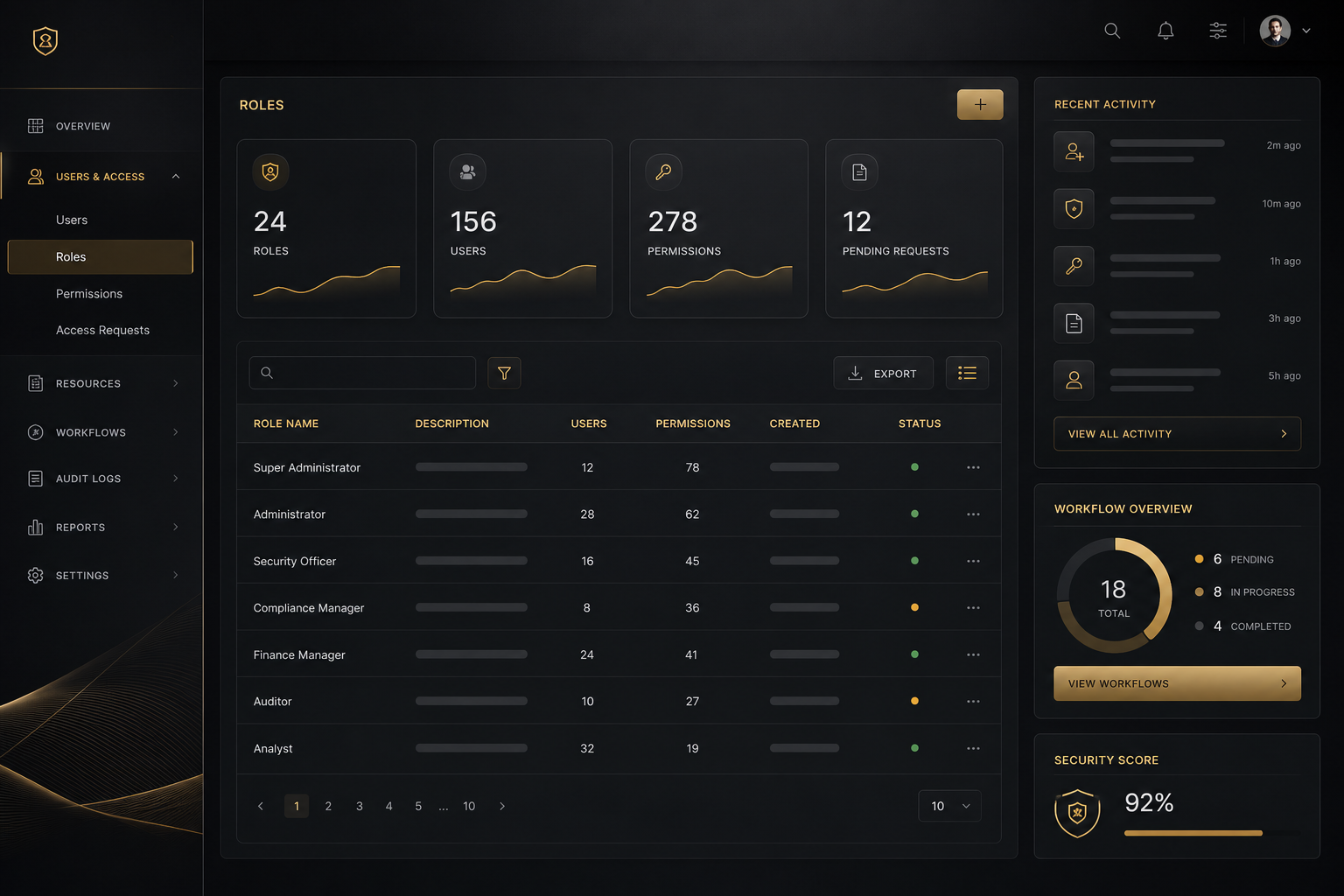
Admin panels occupy a different risk category to customer-facing interfaces. When a customer encounters a bug in a self-service UI, the consequence is frustration and potentially a lost transaction. When an operations manager encounters a bug in an admin panel during a critical workflow — processing a refund, suspending a user account, updating pricing configurations, approving a high-value order — the consequences can include financial errors, customer harm, compliance violations, and the kind of operational incidents that end up in post-mortems.
The engineering requirements that follow from this elevated risk profile are correspondingly more demanding. Role-based access control must be implemented at the component level, not just the route level — an operations manager who lacks the permission to delete accounts must not see the delete button, because seeing it and being denied by a server error is a worse experience than the control being absent entirely. Bulk operations that affect hundreds of records must implement confirmation flows that communicate the scale and irreversibility of the action. Forms that capture configuration data must validate comprehensively before submission and handle submission errors gracefully without data loss. Every state-changing action must be represented in the audit log so that any change to any record can be traced to an actor, a timestamp, and the specific values that changed.
Generic admin panel templates and low-code admin builders cannot meet these requirements. They provide a scaffold for simple CRUD interfaces, but enterprise admin panels are rarely simple — they serve multiple user roles with complex permission matrices, they manage data relationships spanning dozens of entity types, they handle edge cases in business logic that are deeply specific to the organisation's domain, and they must remain performant when the data volumes they manage scale from thousands to millions of records over the product's lifetime. Building an admin panel correctly is a specialised engineering discipline.
We build admin panels that operational teams rely on without thinking about the technology — which is the correct relationship between an internal tool and its users. Every interaction should be exactly what the operator expects, every permission should be exactly what the permission system intends, and every audit log entry should be exactly what compliance requires.
Our approach to admin panel engineering begins with a thorough understanding of the operational workflows the panel supports, the role hierarchy and permission model, and the data volumes and update frequencies involved. These inputs determine every significant architectural decision.
Implementing RBAC correctly in an Angular admin panel requires more than route guards. Route guards prevent unauthorised navigation, but within an authenticated route, a user may have partial permissions — they can view records but not edit them, they can edit records but not delete them, they can process orders below a certain value but require approval for larger amounts. This granularity requires RBAC to be available throughout the component tree, not just at the route level.
We implement a structural directive, *appHasPermission, that accepts a permission key string and conditionally includes or excludes its host element from the DOM based on the authenticated user's permission set. This directive injects the permission service, checks the current user's permission matrix, and either renders the element or removes it from the DOM entirely. Buttons, form fields, table columns, navigation items, and entire sections can all be gated behind permissions using this directive. The server provides the permission matrix at authentication time — a structured object mapping the user's role to a set of permission keys — which is stored in the NgRx store and read by the directive. When the organisation needs to add or modify permissions, they update the permission matrix on the server and the directive reflects the change without any frontend code modification.
Enterprise admin panels typically contain multiple data tables — user management, order management, billing records, audit logs, configuration tables — and each one needs to handle potentially millions of records efficiently. Server-side pagination is not optional at this scale; it is required. But server-side pagination alone does not make a table usable. The table must also support server-side sorting (clicking a column header must trigger a sorted API request, not sort the 20 records currently on the page), server-side filtering (search inputs must query the database, not filter the current page), and column configuration persistence (users who configure their preferred column set should not have to reconfigure it every session).
Inline editing with optimistic updates is a key efficiency feature for operational workflows. When an operator corrects a data value in a table row, showing a spinner and waiting for the API response before updating the UI creates a perceptible delay that multiplies across hundreds of edits per day. Optimistic updates update the UI immediately and roll back to the previous value if the API request fails, delivering a responsive experience while maintaining data integrity. Bulk actions — selecting multiple rows and applying an action to all of them — must implement shift-click range selection, a select-all-on-page control, and a select-all-in-query control for actions that should span beyond the current page. CSV and Excel export must operate on the server-side to avoid transmitting the entire dataset to the client before exporting it.
Admin panels frequently require forms of substantial complexity: multi-step wizards for onboarding new entities, conditional form sections that appear or disappear based on other field values, async validators that check uniqueness against the database in real time, and form state persistence that prevents data loss when users navigate away accidentally and return to resume entry.
We build admin panel forms using Angular Reactive Forms with strict TypeScript typing throughout. Typed form groups make form value access type-safe, eliminating the runtime type errors that occur when accessing untyped form controls. Async validators are implemented with appropriate debouncing to avoid excessive API calls during typing. Conditional form sections are driven by observable form value changes rather than template-side conditionals, keeping the form logic in the component class where it can be unit tested. Multi-step wizard state is managed in the NgRx store, enabling deep-linking to specific wizard steps and preservation of earlier step data when users navigate backward.
Every enterprise admin panel requires a comprehensive audit trail. Compliance requirements in regulated industries mandate that every change to sensitive data be traceable to an actor, a timestamp, and the specific change made. Operational requirements mandate that when something goes wrong, the source of the problem can be identified quickly. Good audit log UX is therefore not a nice-to-have — it is a core capability of a production enterprise admin panel.
We build audit log interfaces with virtualised rendering to handle the potentially very large number of log entries that accumulate over a product's lifetime. Filtering by user, action type, affected entity, and date range allows operators to find relevant entries quickly. Each log entry expands to show a before-and-after diff of the affected record's state, rendering changed fields with clear visual differentiation between the previous and new values. Audit log entries link to the affected entity's current state, enabling quick context-switching between the audit history and the live record.
Describe your admin panel requirements — user roles, key workflows, data volumes — and we'll respond with a direct technical assessment.
Start the ConversationRelated Services
Structural directive-based permission gating that removes restricted elements from the DOM entirely. Server-provided permission matrices with zero code changes when permissions evolve.
Server-side pagination, sorting, and filtering. Inline editing with optimistic updates. Shift-click range selection. Bulk actions. Column persistence. CSV/Excel export from server.
Typed Angular Reactive Forms, multi-step wizards with state persistence, conditional sections, async validators, and form error handling that never loses user-entered data.
Virtualised audit log tables with before/after diff views, filtering by user, action, entity, and date. Full traceability of every state-changing operation in the panel.
Tenant management panels for SaaS products — tenant creation, feature flag management, subscription tier configuration, and user management scoped to each tenant.
Multi-field search with relevance ranking, faceted filtering with live counts, saved search views, and URL-persisted filter state for shareable filtered views.
The key architectural decision is to treat permission data as server-authoritative configuration rather than frontend logic. At authentication time, the server returns a permission matrix for the authenticated user — a structured object specifying what the user can read, create, update, and delete, at entity-type granularity and in some cases at attribute granularity (can edit all fields on a user record, or only specific fields). This matrix is stored in the NgRx store and consumed by the structural permission directive throughout the application. Role hierarchies — where an admin role inherits all permissions of a manager role, which inherits all permissions of an operator role — are resolved server-side, so the frontend receives a flat, resolved permission set rather than needing to implement inheritance logic. This means permission changes require only a server-side update, with no frontend deployment required.
Yes, and this is the standard case. We integrate with your existing authentication system rather than replacing it. Whether you use OAuth 2.0 / OIDC with a provider like Auth0 or Okta, a custom JWT-based authentication system, or a session-cookie system, we implement the Angular HTTP interceptor layer to attach credentials to every API request and handle token refresh automatically. The permission matrix we use for RBAC is an additional endpoint on your existing user API — it returns the resolved permissions for the authenticated user and is called once at session start. No changes to your authentication system are required.
Optimistic updates are applied to the NgRx store immediately on user action, while the API request is in flight. If the API request succeeds, no further action is needed — the store reflects the correct state. If the API request fails, we dispatch a rollback action that returns the affected entity to its previous state and displays an error notification explaining what failed. The critical safety mechanism is idempotency: we ensure that every mutating API request carries a unique idempotency key so that network failures that cause retries cannot accidentally apply the mutation twice. For operations with particularly high consequences — bulk deletions, billing configuration changes — we implement a confirmation step that describes the operation and its scope before allowing submission, and this step is not bypassed by optimistic updates.
Non-technical operators are actually more demanding users than technical ones, because they rely entirely on the clarity of the interface — they cannot fall back to understanding the underlying system when the UI is ambiguous. This means every action must have a clear label that describes exactly what it does, not technical jargon. Every confirmation dialog must state specifically what will happen and to how many records. Every error message must say what went wrong and, where possible, how to resolve it — not an error code or a generic "something went wrong." Status indicators must use unambiguous language and visual hierarchy. We design admin panels with explicit attention to the cognitive load on operators who are making many decisions rapidly, and we treat error prevention — making it difficult to perform destructive actions by accident — as a core design requirement, not an afterthought.
Describe your admin panel and we'll respond with a direct technical assessment of how we would approach it.